Read the original sources
Unlock the writings of Ephrem, Aphrahat and the Church Fathers in the language they were composed in — no translation between you and the text.
Learn Syriac Online
Learn Classical Syriac with Malphono George A. Kiraz — from the first letters to reading Ephrem, Aphrahat, and many other Church Fathers.
Why learn Syriac
Syriac carries two millennia of scripture, hymnody and scholarship. Read it and the library opens without a translator standing between you and the page.
Unlock the writings of Ephrem, Aphrahat and the Church Fathers in the language they were composed in — no translation between you and the text.
Learn the authentic pronunciation of Syriac, preserved through an unbroken chain of oral tradition — the sounds behind the letters, not just the shapes.
Learn directly from Malphono George A. Kiraz, whose grammars and critical editions are used in universities worldwide.
Where every student begins
Syriac is written right to left in a cursive hand. Hover any letter for its name and sound — the same names taught in the schools of Edessa and Nisibis centuries ago.
Set in Serto Antioch Bible — the font used to publish the Antioch Bible Syriac-English New Testament. Letters are shown in their isolated form; joined forms are taught from the first lesson.
Our curriculum
Each level is a complete course with structured lessons, written exercises and direct feedback from the Malphono.
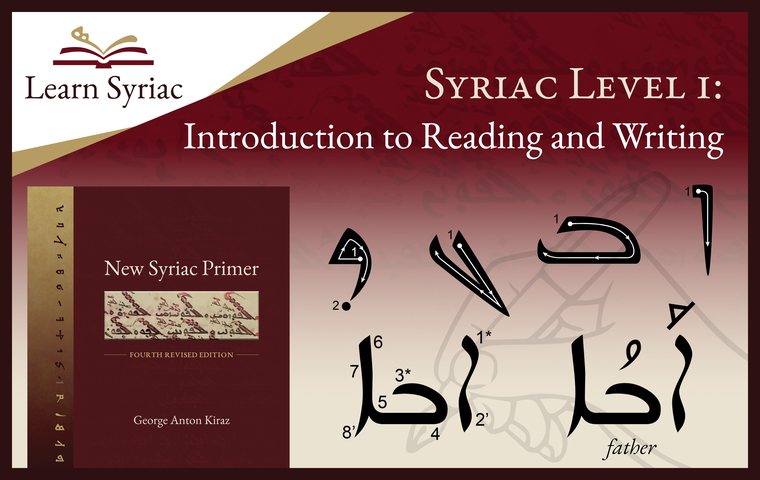
For students with little or no prior knowledge of Syriac. You begin by learning to read and write the alphabet, then progress to simple words and basic sentences.
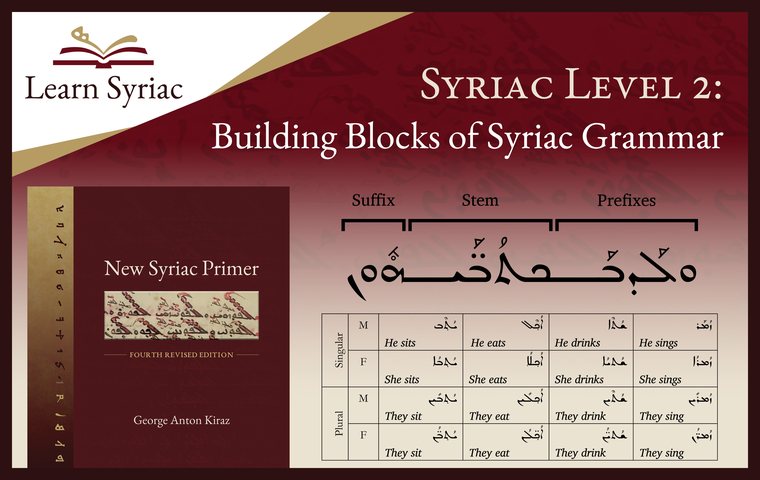
The next step after learning to read and write the script. It introduces the foundational elements of Syriac grammar and how the language works structurally.
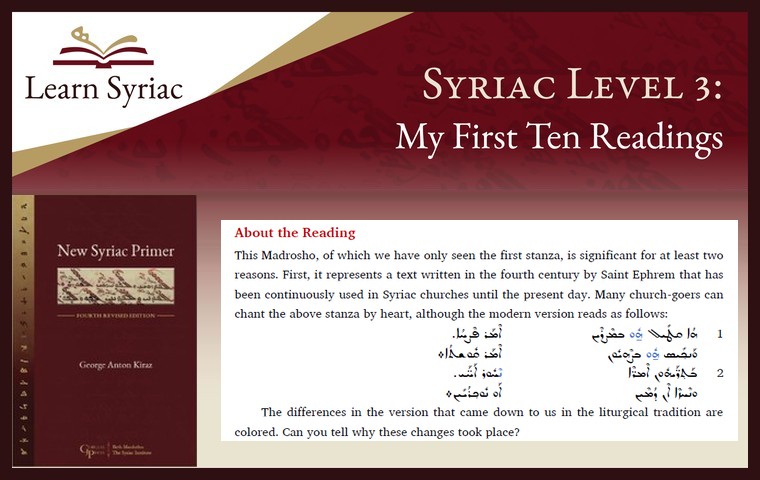
Your first 10 readings from Syriac literature. You'll learn about the life of St. Ephrem — told in Syriac — and read one of his own texts, alongside two poems, including a Sugitho, the classical dialogue-poem form. From there, you'll explore the ancient Proverbs of Ahiqar, a fable of a wolf, a fox, and a lion, a reading from the liturgy, and the Lord's Prayer.
Live on Zoom · Saturdays
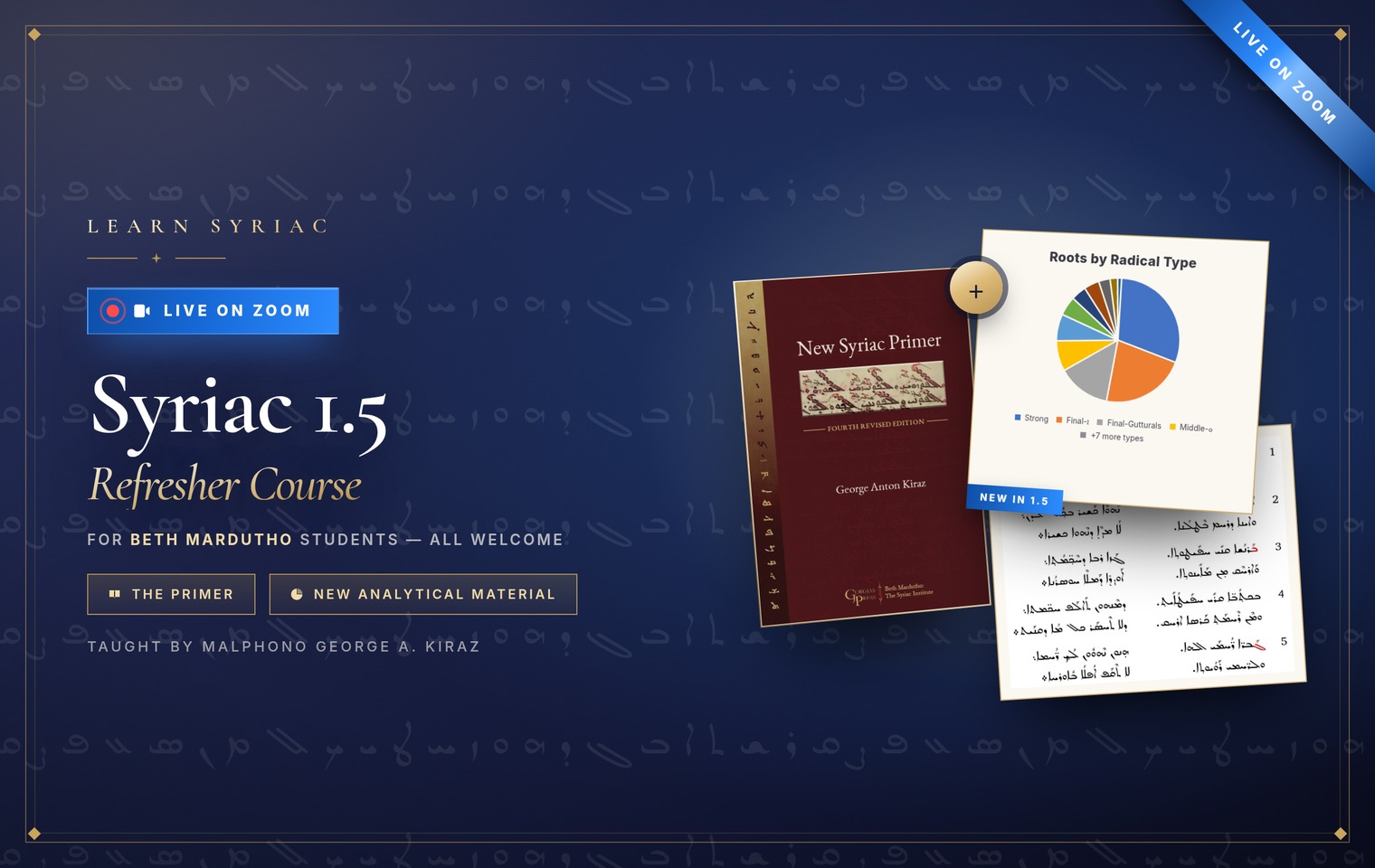
Between Syriac I and Syriac II. Ten live sessions that pick up the Primer at Chapter 6, with supplementary readings and further grammar added to every lesson by the Malphono. Written for Beth Mardutho students — and open to everyone who qualifies.
Entry: Beth Mardutho’s Syriac I or equivalent — or take the placement test and land at Level 3.
Levels 1, 2 and 3 are one path, not three purchases. Taken together they come to $850 instead of the $1,050 they list for — and the whole semester stays yours for good.
Full list price of the three levels: $1,050. Lifetime access, no renewal.
Our heritage
From the scriptoria of Edessa and Nisibis to the monastic libraries of the Middle East, generations of Syriac scribes copied scripture, hymns and commentaries with extraordinary devotion and artistry.
That living tradition continues. Every lesson you take is a thread connecting you to an unbroken lineage of scholarship, prayer and the written word.
Meet the Malphono“I completed Syriac I last summer and decided to return for Syriac II since I am currently doing fieldwork on the Syriac Orthodox church. It has been quite challenging, but it has been very rewarding to be able to read Ephrem and Aphrahat after only five weeks.”
Anna Hager, PhD
Postdoctoral Researcher · Radboud University
Our Malphono
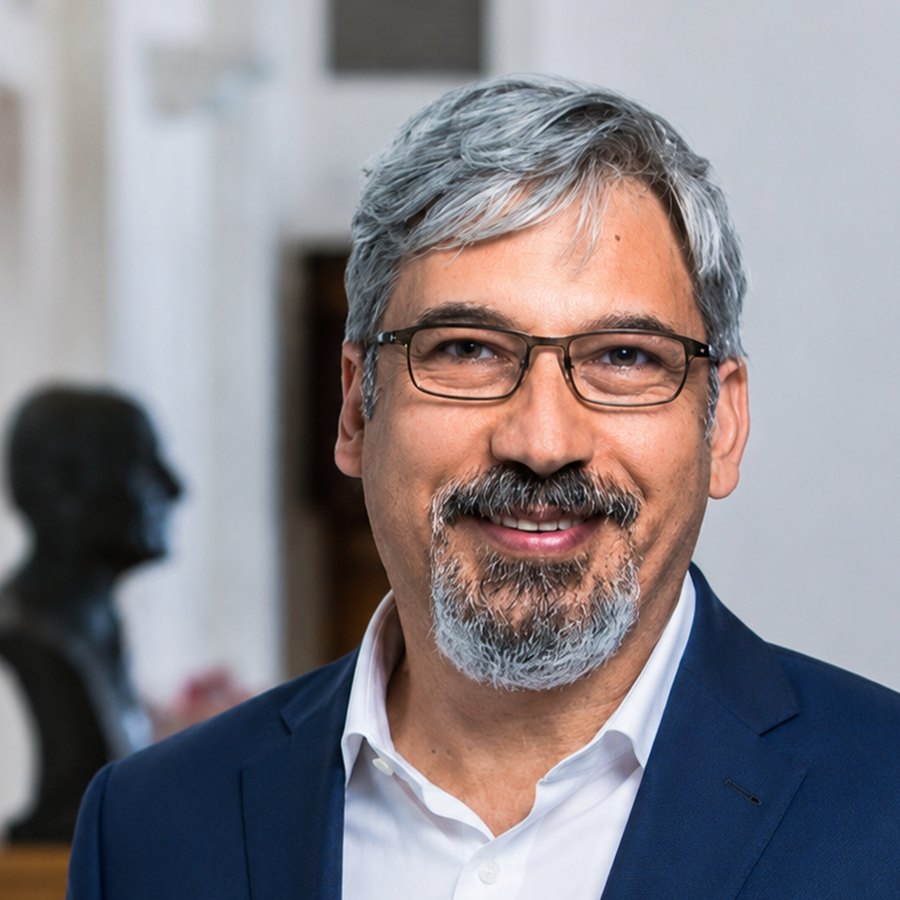
Director, Beth Mardutho: The Syriac Institute
George A. Kiraz taught Syriac language and literature at Princeton University, the University of Cambridge (UK), Beth Mardutho, the University of Tennessee Knoxville, Rutgers University, and the POLIS Institute in Jerusalem, guiding students from first encounters with the alphabet through advanced readings in classical and liturgical texts.
His teaching is grounded in a lifetime of immersion in the language — from learning Syriac as a boy at the Monastery of Saint Mark in Jerusalem, to earning advanced degrees in Syriac Studies from Oxford and in Computational Linguistics from Cambridge. As author of New Syriac Primer, one of the most widely used introductory textbooks in the field, George has helped shape how a generation of students first learns Syriac, combining rigorous grammar instruction with deep familiarity with the language's literary, liturgical, and manuscript traditions.
Before you begin
None at all. Syriac Level 1 assumes you have never seen a Syriac letter. If you can read this sentence, you can start on the first day.
Syriac has been written in three beautiful scripts over the centuries: Estrangela, the oldest; Serṭo, which emerged in the 7th–8th century and became the classic West Syriac hand; and Madenḥāyā, the East Syriac script. You'll start with Serṭo, since it's the script used in most Western grammars and dictionaries — the natural place to begin. As you advance, you'll go on to learn all three scripts, plus how to read them in manuscript hand.
Pace varies by student. At Princeton, Malphono George teaches Levels 1–4 in a single semester; at other universities, Levels 1–3 in one semester. That gives you a sense of what's possible — but here, the course is self-paced and access never expires, so if you'd rather take it slower, it costs you nothing.
Lessons are recorded so you can study on your own schedule, but written exercises are reviewed personally by the Malphono. You are taught, not left alone with a playlist.
Yes — and it's worth it if you'd like a bundle price on multiple levels. Just work through them in order, finishing one level before moving to the next, so each builds properly on the last.
The courses are self-paced, so enrollment is always open — begin the day you sign up, and take it at whatever pace suits you.
Create your account